
Look at the reasons people leave organisations. Ever seen “Because the Company recruited the wrong person in the first place.”? No? Why do you think that is?
There are a few reasons:
- Most of these lists are written from the perspective of the employee who may not even know that’s why they were fired.
- Even if they do know, they probably wouldn’t want to admit it so fall back on one of the “more money/ work/life balance/ my boss didn’t understand me” reasons.
- Organisations (or, more precisely, the people in them), if asked, would not want to admit that someone left because they got it wrong in the first place either.
It begs the question: Is that why so few organisations record the cost of poor recruitment?
And yet, when they (should) know it costs at least 50% of the annual costs of every person that leaves early, it’s beyond me why more Finance Directors haven’t woken up to it as a significant cost to the business.
It also begs the question if a business has ‘professional recruiters’ why does it keep happening?
Again, there are multiple reasons:
- Many recruiters are targeted on a ‘bums on seats basis’, not on recruiting people who stick around.
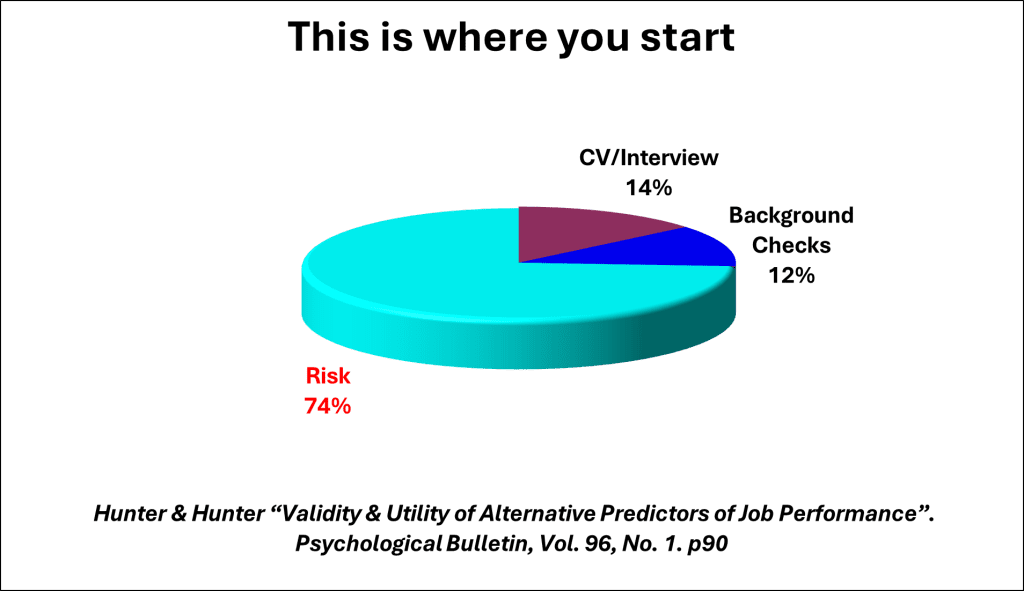
- Most recruitment decisions are made using a maximum of 26% of the information available (from an Interview/CV and Background Checks). Even someone with a basic grasp of maths can see that tossing a coin gives you a 50% chance of success.
- Line managers are often responsible for the final decision and, with many having an inherent belief that they’re “great judges of character”, have an “instinct for the right people” and are “brilliant interviewers”, what could possibly go wrong?
You don’t have to look too far to find what can go wrong because it’s happening all the time. Every day organisations recruit salespeople who can’t sell, finance people who can’t count and customer service people who p*** customers off on a daily basis.
Getting it wrong with one person is expensive but, if the process is poor, it’s rarely just one person. And yet, even after showing poor employees the exit, no one seems to spend the time finding out how they got through the entrance in the first place. It’s amazing how few people ask:
- What did we do wrong when we recruited them?
- What DIDN’T we do that would have stopped them even making the shortlist, let alone the payroll?
What can you do?
The answer’s simple. Look for the other 74% of the information that would mean making much better-informed hiring decisions because every 1% of INFORMATION you DON’T have is an extra 1% of RISK you’re taking.
Where will that information come from?
I’m glad you asked – it’s through using Recruitment Assessments, of course.
What can assessments tell you that you don’t already know?
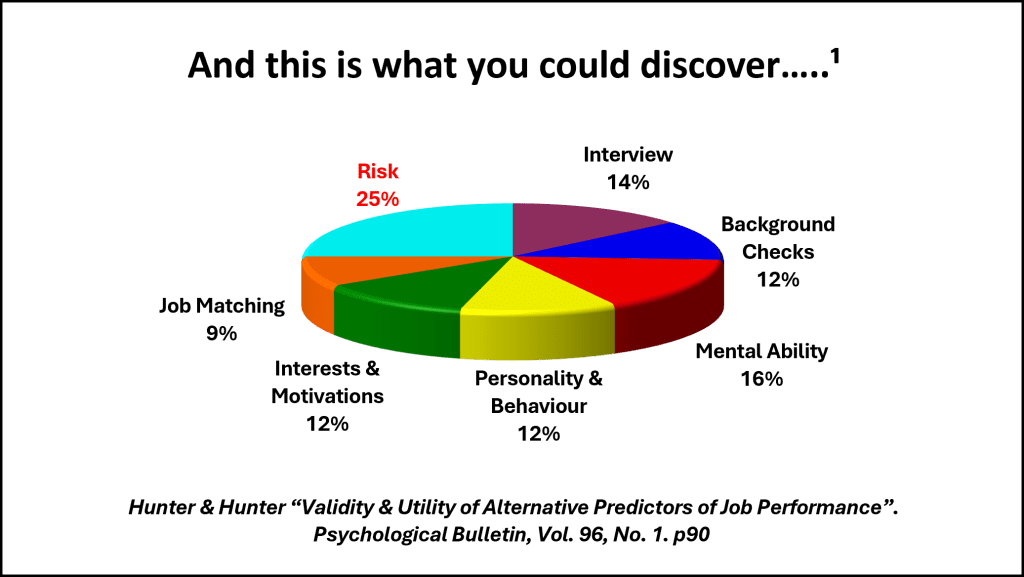
¹ if you use the right assessments
So, what have we added?
Mental Ability
Not how clever they are but how they evaluate and process verbal and numerical information and how this influences their ability to reason.
Personality and Behaviour
It’s all about Attitude vs Aptitude. Most organisations recruit people who can ‘do the job’ but forget that skills can be acquired, whereas character and attitude are much harder to change.
Interests & Motivations
Independent research shows a high correlation between professional interests and workplace motivation/performance. That’s why all good Recruitment Assessment providers include a section on Interests. These gauge where your candidate’s priorities are and help identify the level of performance you can expect, based on the comparison between the candidate and the key characteristics of the job.
But surely there’s something missing?
The elements, above, are incredibly valuable but there is a ‘secret sauce’ that combines them into a powerful predictor of future success for a candidate you’ve never met before.
That ‘secret sauce’ is:
Job Matching
Knowing what you’re looking for in a new candidate – but not having the mechanism to compare them consistently – can be why so many new employees fail to make the grade.
Knowing the psychological profile of a candidate but not being able to compare it with the requirements of the job, on the same basis, is of zero value to organisations – yet it’s all that assessments, not designed for recruitment (and many aren’t), give you.
Job matching is the process by which an employer defines the requirements of a role using their current top performers in that role, then compares candidates with them. The process is very simple:
- Top performers take the assessment and their results generate the benchmark against which all candidates will be compared.
- Candidates take the assessment and their results are compared with the benchmark.
- The higher the correlation, the greater the likelihood that they can perform at the level of your top performers today.
- And, better still, you can have the confidence of knowing that assessments that offer this have been validated to do it reliably time after time (after time).
Every penny you spend on onboarding and engagement is wasted – unless you use the right Recruitment Assessments to recruit the right people in the first place.
Poor recruiting carries a high cost for any organisation. The right recruitment assessments are a worthwhile investment in making sure that what you spend later, on onboarding and engagement, ISN’T wasted (and nor is the money you spend on recruiting the RIGHT people first time, every time).