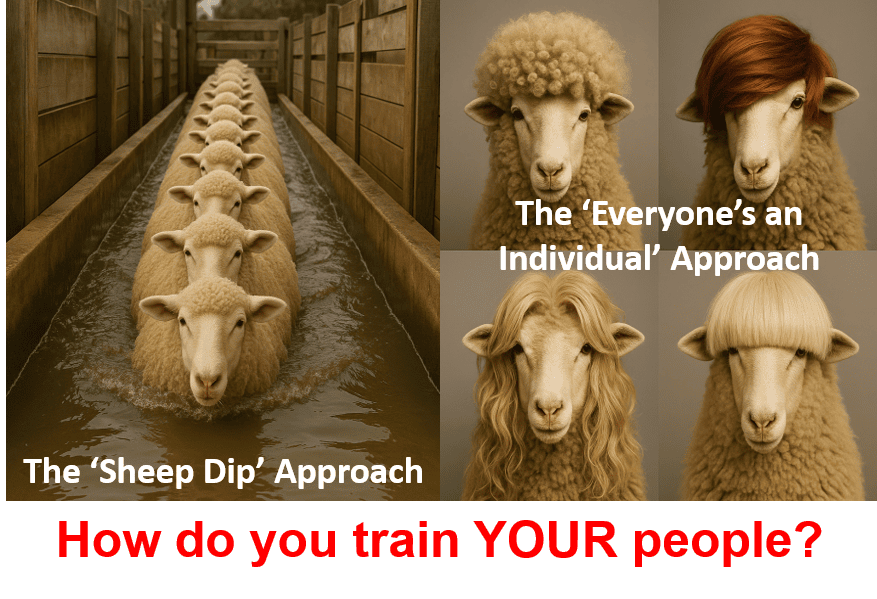
Remember ‘sheep dip’ training? Some of you may remember it better than others – perhaps because it’s still happening where you are.
Organisations are spending huge amounts of money on training that, while it might work for some employees, misses the mark with most of the rest and can even have a negative impact on a percentage of their workforce.
The “sheep dip” approach is ‘one-size-fits-all training’ that many/most businesses inflicted on their workforces in the past. It’s like herding every employee and dipping them all in the same “training bath” — whether they need it or not.
What does ‘Sheep Dip’ training look like (so you can tell if you’re doing it or not)?
- Uniform: Every employee gets the same training content.
- Mass-Delivered: Often rolled out through big workshops, usually mandatory sessions.
- Totally generic: Doesn’t account for different job roles, skill levels or career goals.
- Tick-Box Exercise: Often done to meet compliance or HR targets rather than to genuinely develop people.
Why do Companies use it?
- Easy to organise: All you need is the trainer, materials, room and time.
- Quick: You don’t need to run many sessions. The size of the group in the room is only limited by the size of the room.
- Good on paper: “Everyone has completed leadership training.” Impressive (or not)!!?
- Cost-efficient: At least at first glance but may not survive more detailed analysis.
- Consistent. Everyone gets the same message – but this ignores the question of whether everyone NEEDS the same message?
Unfortunately, sheep dip training:
- Wastes time and money
- Skilled employees sit through training they don’t need.
- New employees may not get enough depth to really help them develop.
- Kills engagement
- People feel frustrated or insulted (“I already know this” or “This doesn’t apply to me”).
- Training is seen as boring and pointless.
- People less likely to maintain concentration on information they don’t need and might miss the snippets they do.
- Easy for people to ‘disappear’ at the back of the room.
- Misses real development needs
- Doesn’t address individual gaps or growth opportunities.
- Leaves high-potential employees underdeveloped.
- Fails to change behaviour
- Because it isn’t personally relevant, very little gets applied back at work.
- Real behaviour-change needs tailored support and practice.
So what’s the alternative?
Training shouldn’t be just about what you deliver. It should also be about the relevance of what the trainees receive, retain and benefit from. Instead of sheep-dipping, high performing (and, almost invariably, successful) organisations aim for targeted, tailored individual development to achieve it.
This involves:
- Personalised learning journeys – based on assessment of individual training needs
- Modular programmes – pick-and-mix learning paths
- On-the-job coaching and mentoring -identifying development needs through observation and conversation).
- Skills-based development – aligned to the future needs of each individual, not just what they need today
This approach feels relevant to individuals, respects their time, motivates them and can genuinely drive performance improvement.
Identifying individual development needs
It sounds easy – when you say it quickly – but it’s a critical (and often overlooked) step to building a high-performing workforce.
Here are some practical steps to implement it in your organisation:
a. Skills & Role Mapping
- Define what success looks like: What skills, knowledge and behaviours are needed to perform well in each role?
- Create a skills matrix: Map out technical, soft, leadership and future-ready skills needed at each level.
- This gives you a clear benchmark against which to assess people.
b. Use Self-Assessment
- Ask employees to assess their own skills and confidence levels.
- Ask questions like: What do you find challenging? What do you want to strengthen?
This can build self-awareness and highlight hidden knowledge, experience and development goals, as well as involving the individual in their own development.
c. 360˚ Feedback
A 360˚ survey:
- Collects feedback from the individual and compares it with feedback from:
- Managers
- Peers
- Direct reports (if applicable)
- Others
- Uses structured survey questions focusing on skills, behaviours and leadership capabilities.
- Reveals blind spots — things people don’t always see in themselves – and not just the negatives. We are often the last people to see the things we do well.
- Will tell us what, in the opinion of others, we do well.
d. Performance Reviews (but not just looking at the past)
Instead of only judging past performance, use review discussions to explore:
- Where they’re strong
- What they find more difficult
- What future roles or responsibilities they aspire to
- Development-focused questions like: Where do you want to grow? What would help you be more effective?
Turn reviews from a post-mortem into the past to forward-looking development conversations.
e. Assessment Tools
Use psychometric assessments, technical skills assessments or leadership potential evaluations like:
- Personality profiles
- Cognitive ability tests
- Situational judgment tests
- Great People Inside!!
Objective data helps you validate what you see in subjective feedback. At Great People Inside, we always say that our 360˚ Feedback Survey tells you what’s happening, and our Psychometric Assessment tells you why.
f. Future-Readiness Gap Analysis
- Compare current skills against future business needs (e.g., AI skills, remote leadership, change management). It doesn’t only provide benefit to the individual, it’s huge for the business too.
- Enables you to identify gaps now before they become critical.
- Ensures development isn’t just about “fixing today” but preparing for tomorrow.
g. Focus on strengths as much as/more than weaknesses.
Developing natural strengths into superpowers often delivers bigger returns than just “fixing gaps.”
Sheep dip development is fast, easy – and mostly ineffective…
..BUT if you want real growth, and ROI, from training, you have to focus on individualised, relevant and strategic, development paths.
It’s not always an easy journey, but the destination definitely makes it worthwhile.
Talk to us at Great People Inside and let us tell you how we can help.