
I’m calling BS on all the people who think that once you know what generation someone comes from, and then consult a useful summary chart (like the one below), and treat your staff accordingly, you’ve “cracked” the generation game (Good Game, Good Game – IYKYK).
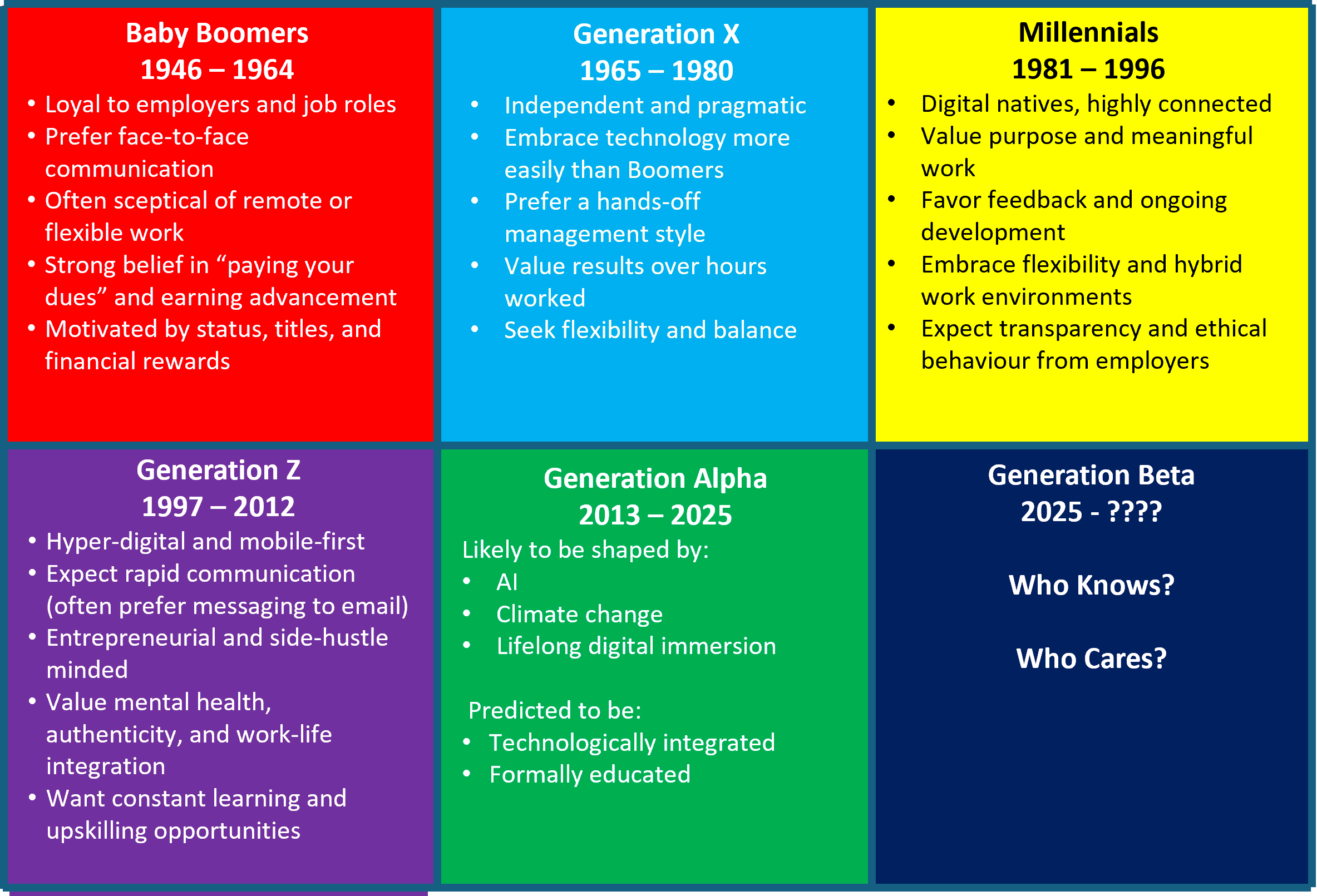
DOES EVERYONE REALLY FIT INTO THESE NEAT BOXES?
You must have heard it too – “The problem with the younger/older/other generation is….”.
What usually follows is a litany of what’s wrong with every other generation but our own.
The problem is, if you got 100 people in a room, born on the same day as you, in the same town, with the same background, the differences (beyond the obvious of male/female etc) would be immediately apparent. Being born into a generation will, inevitably, provide some common factors. It will also provide a huge spectrum of things we share with a relatively small number of people – and not necessarily in the same generational ‘box’. And if we only focus on the things people have in common, what are we missing?
Which begs the question:
“Isn’t putting people into generational boxes, just another way to make life more convenient for ourselves? And isn’t it just as nonsensical as any other form of overgeneralisation?”
If you design your people approach based on the generation individuals are born into, you will miss what drives most people in just the same way as you do if you completely ignore it.
There’s a simple truth here. PEOPLE ARE INDIVIDUALS and it doesn’t matter how f*****g old (or young) they are. How they behave, and what they’re looking for isn’t a product of the generation they were born in so much as a product of the influences they’ve had as they grew and developed.
The truth is (to over-generalise) that over-generalisation is a hugely dangerous thing to base your decisions on.
And is there REALLY any difference between someone born on 31st December 2012 (Gen Z) and someone born on 1st January 2013 (Gen Alpha). If not, where DO you draw the line (if at all)?
WHY NOT TREAT EVERYONE AS INDIVIDUALS?
Is it difficult? – YES. Is it worth it? – YES (if you do it well and show them you mean it). Will your business benefit from this approach? – YES, YES & YES.
Ah, but the problem with treating them as individuals is you have to know them as individuals, and that could mean (shock, horror) talking to them to find out what makes them tick, what motivates them, where do they REALLY see themselves in 5 years’ time.
But here’s the news – it doesn’t have to involve any of that. However interesting (not) it might be to know EVERYTHING about the people working for you, what you really want is to know if their aspirations match those of your organisation.
Forget ‘Culture Fit’. ‘Aspiration Fit’ is the new fitness regime you should be aiming for. And how do you find out about Aspiration Fit? Why, (the right) assessments, of course.
HOW WILL ASSESSMENTS HELP?
Assessments are ‘age-agnostic’. If an employee’s aspirations match your organisation’s aspirations, the assessment will tell you – regardless of their age (young OR old). It will not know (or care) how young or old they are.
Assessments are also agnostic to all the other protected characteristics you might encounter, giving you a very inclusive process to set up your organisation for future success.
HOW DOES IT WORK?
We can only speak for Great People Inside but we will work with you to define where you want your business to be, how we can measure it. We’ll then create the assessment that does exactly that (and the creation process won’t cost you a bean).
Once that’s done, there’s a quick step to create a benchmark for your people and you have a practical, simple assessment you can use on your entire team to see who meets your aspirations, who could do with a little help and who’s unlikely to make it.
And the bonus? You can use the same tool when you recruit as well to ensure that, whoever you hire, however old they are and whatever added skills and knowledge they bring with them, they will fit into the existing team and be comfortable with the direction of travel.
Employing people across the generations provides your organisation with the diversity of thought that can be hugely beneficial for you – provided it’s all facing the same, general direction. A multi-generational workforce, with a clear and common purpose, can drive innovation, resilience and high performance.
Assessments don’t clone people (contrary to popular belief). But they can ensure that existing, and new, employees have what you need, regardless of the generation they were born into. You will still retain the creativity and variability of thought that challenges conventional wisdom, without hiring mavericks that divert attention away from the goals you have.
If you’ve decided you ‘Won’t get fooled again’ and your business won’t become a ‘Teenage Wasteland’, Great People Inside can provide the tools that will let you ask everyone on the team (and future team members) ‘Who are you?’